
A multi-location restaurant brand we work closely with — Location #1 and Location #2 — faced the same challenge every restaurant does: getting found online, and turning that visibility into actual tables filled and orders placed. Here’s what the numbers actually show, comparing the identical 90-day window one year apart, pulled directly from Google Ads and the brand’s own listings data. (A third location launched partway through this year and is deliberately excluded from these figures — this is a clean, apples-to-apples comparison of the two locations that existed in both periods.)
The Reputation Side: Reviews Up 44% Year Over Year
Across both locations combined, this client grew from 856 reviews (May – August 2025) to 1,232 reviews in the same window this year — a 44% increase, comparing the same season rather than an arbitrary short window. That kind of growth usually comes with a rating dip as new reviewers weigh in, but the average held essentially flat: 4.60 stars in 2025, 4.63 in 2026.
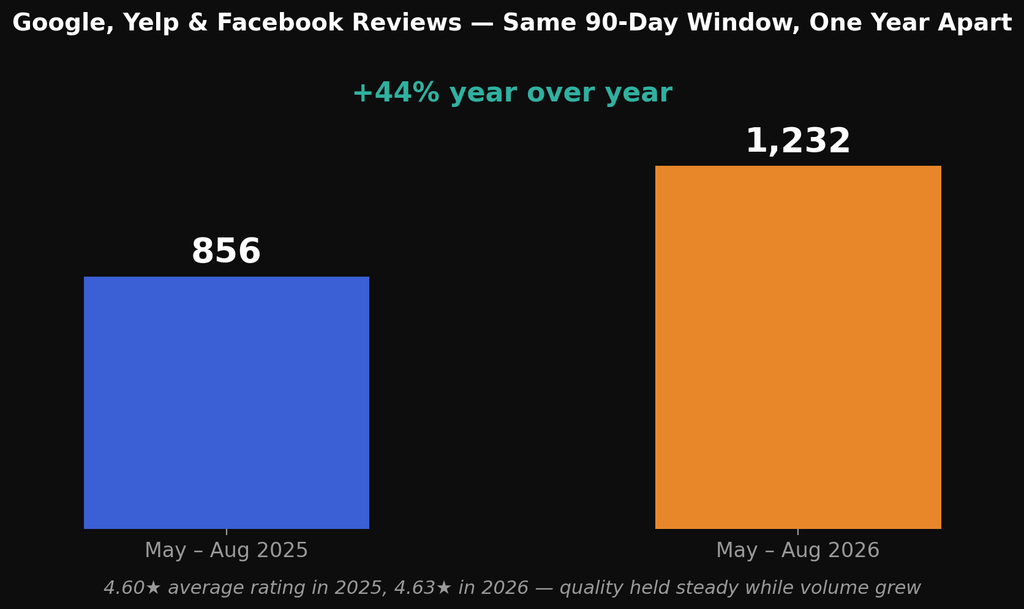
More reviews, sustained quality — that combination is what actually moves the needle on local search visibility, since Google weighs both volume and rating when deciding which businesses to surface first. This is exactly the kind of growth our reputation management work is built around.
The Paid Search Side: More Results, Less Spend
Ad platforms love to report “conversions,” but that number is often a blend of things that don’t actually mean much on their own — page views, phone number clicks, direction requests. We pulled the real breakdown directly from Google Ads’ location-level reporting, isolating just the two metrics that actually matter for a restaurant: people showing up, and people ordering — for both locations specifically, comparing the identical 90-day window one year apart.
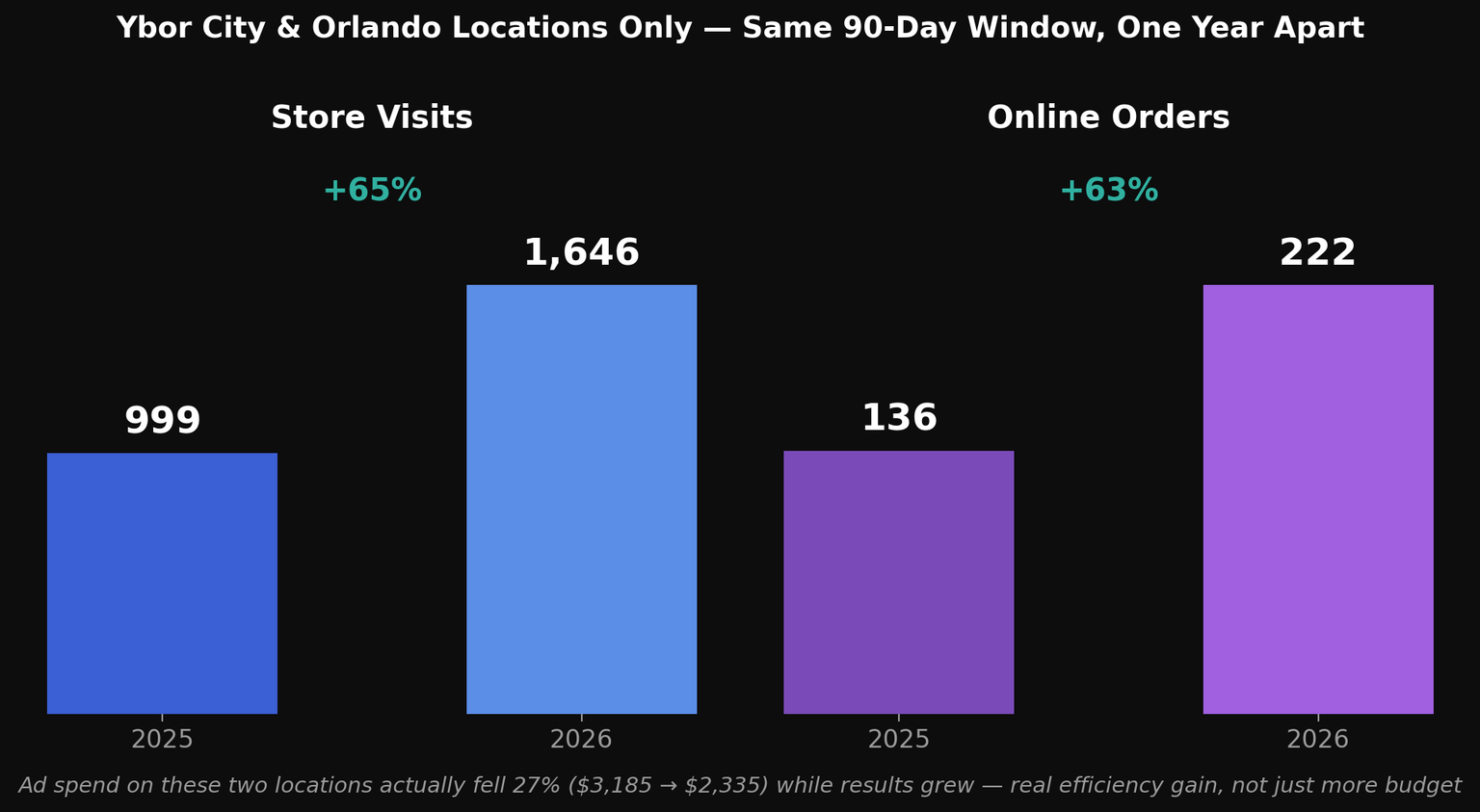
Store visits grew 65% (999 → 1,646) and online orders grew 63% (136 → 222) — while ad spend on these same two locations actually fell 27%, from $3,185 to $2,335. That’s the number that matters most to a business owner: real, meaningful growth achieved with a smaller budget, not a bigger one.
Why This Combination Matters
Reviews and paid search aren’t separate efforts — they reinforce each other. A stronger review profile improves ad quality scores and lowers cost-per-click over time; well-targeted local ads bring in the kind of first-time visitors who go on to leave the next round of reviews. This client’s year-over-year numbers show both halves of that loop compounding at once, on a leaner budget than the year before. If you’re running multiple locations yourself, our guide to local SEO strategies for multi-location brands covers the foundational work, and our complete guide to restaurant reputation management walks through the review side in more detail.
Common Questions
How were these results measured?
All figures came directly from Google Ads’ own location-level reporting and Marqii listings management data, comparing the identical 90-day window (May 25 – Aug 22) one year apart. Nothing was estimated or modeled after the fact.
Is this kind of growth typical for restaurant marketing clients?
Results vary by starting point, market, and how long a location has been actively managed. This case reflects two established locations with a full year of consistent management behind them — newer locations or different markets may see different timelines.
What caused ad spend to go down while results went up?
A combination of factors: campaigns had a year to optimize toward what was actually converting, and improving review volume and ratings tend to lower cost-per-click over time by strengthening ad quality scores. The two channels reinforced each other rather than working in isolation.
Does this apply to single-location restaurants too?
The same underlying principles — consistent review growth paired with well-targeted local ads — apply regardless of location count. This case study focuses on a multi-location brand specifically because that’s where year-over-year, location-level comparison data was cleanest to isolate.
Data pulled directly from Google Ads (May 25 – Aug 22, comparing 2025 to 2026) and Marqii listings management (same 90-day window, both years) for two locations of a multi-location restaurant brand we work closely with. A third location, which launched after the 2025 comparison period, is excluded from all figures above to keep the comparison accurate; its early performance is genuinely strong but belongs in its own story once it has a full year of history.